Tuesday, November 5, 2019

Monday, November 4, 2019
Enhanced Ecosystems
Center for Eco Literacy. In my last blog, I discussed that diversity favors balance which supports resilience. All this enhances ecological stability. Resilience encourages the plants built-in resistant traits. Healthy plants are less prone to diseases and insects. Plants have defense mechanisms that help them deal with insects and diseases. Plants use metabolites to help them digest the nutrients they need. Secondary metabolites help build plant defense mechanisms. Monoterpenoids and sesquiterpenoids are the main components of essential oils. These are toxic to insects. They also inhibit bacterial and fungal attacks. Phytoecdysones can mimic insect molting and disrupt the development of larvae. These also contain anti fungal properties. Defensins are another defense mechanism contained in plant proteins. Besides this, plant resistance also depends on structural barriers between cells. When there is a disturbance the cells are triggered and increase growth that blocks disease from entering. A good example of defense mechanisms is, when temperatures drop near freezing plants are triggered to send sugars out into the leaf. Sugars freeze at a lower temperature then water. This way the plants are more protected and we harvest the more nutritious and sweeter greens after a good frost. Plant roots are highly sensitive. Plant roots can release root exudates that are anti microbial to inhibit diseases. When plants have an imbalance of nutrients they excrete certain compounds that make them attractive to diseases. Diseases in nature act as the culling out of weaker species. The diet of insect is more carbon than ours. So insects are less attracted to healthier plants.
So can we mimic these behaviors through hybridization to support this type of development? It does work on a very short term basis with GMOs. Yet this short term is not truly sustainable. It relies on outside inputs and artificial interaction. This means it addresses issues on a one dimensional level. The dynamics of a biologically balanced ecosystem is three dimensional and difficult, if not impossible to manifest with genetic interference. To facilitate the forces of nature is to hold obedience and reverence to the laws of nature. Nature works in multidimensional patterns.
So creating a healthy environment is key to growing the best plants. This is done both above and below the ground. With diversity I incorporate my cut flowers or herbs in or near beds with vegetables and fruit. They attract beneficial ones and deters unwanted ones. This is part of Integrated Pest Management (IPM). Here is an example. Buckwheat attracts a wasp that preys on squash bugs. Grasses harbor spiders. Grasses also attract leafhoppers and thrips that can be vectors of disease. that can be a problem for grapes. So grasses are allowed around squash but not grapes. With diversity I try to introduce compatible relationships. Learning what works is an ongoing process. The dynamics of each microcosm is unique. Plants adjust to their surroundings. If I were forming an education group, I would prefer it to develop organically. Plant groupings develop their own dynamics. In ecosystems the ability to adjust to their environment is very important. Each garden setting is unique and a one of a kind. It's individuality favors it's beauty. Plants acclimate to more extreme weather than ever before. So hardy plants are needed to deal with these challenges. Healthy soils create healthy plants. Biotic or biological factors are important to maintain. Cynobacteria (blue green algae), azospirillum, rhizobia, and antinomycetes are just a few bacterial that build healthy soils. The best way to encourage this is with quality compost. I try to use diverse manures in my piles. I also use minerals like granite sand (high in K). I also use high nutritious plants like compfrey, stinging nettles, dandelions, yarrow, chamomile, Good compost does so much. Epigenetics: the study of changes in organisms caused by modifications of gene expression rather than alterations of the genetic code itself (which is what GMO is trying to do. Plant growth substances (phytohormones) that promote cell division or cytokinesis. A PH of 6.5 helps make nutrients available to plants. Soils that hold water yet drain and breathe are important to a healthy biology in the soil. Being a good steward of land is a commitment that comes with an ongoing learning process. There is more information in my book, Radical Regenerative Gardening and Farming.
So can we mimic these behaviors through hybridization to support this type of development? It does work on a very short term basis with GMOs. Yet this short term is not truly sustainable. It relies on outside inputs and artificial interaction. This means it addresses issues on a one dimensional level. The dynamics of a biologically balanced ecosystem is three dimensional and difficult, if not impossible to manifest with genetic interference. To facilitate the forces of nature is to hold obedience and reverence to the laws of nature. Nature works in multidimensional patterns.
So creating a healthy environment is key to growing the best plants. This is done both above and below the ground. With diversity I incorporate my cut flowers or herbs in or near beds with vegetables and fruit. They attract beneficial ones and deters unwanted ones. This is part of Integrated Pest Management (IPM). Here is an example. Buckwheat attracts a wasp that preys on squash bugs. Grasses harbor spiders. Grasses also attract leafhoppers and thrips that can be vectors of disease. that can be a problem for grapes. So grasses are allowed around squash but not grapes. With diversity I try to introduce compatible relationships. Learning what works is an ongoing process. The dynamics of each microcosm is unique. Plants adjust to their surroundings. If I were forming an education group, I would prefer it to develop organically. Plant groupings develop their own dynamics. In ecosystems the ability to adjust to their environment is very important. Each garden setting is unique and a one of a kind. It's individuality favors it's beauty. Plants acclimate to more extreme weather than ever before. So hardy plants are needed to deal with these challenges. Healthy soils create healthy plants. Biotic or biological factors are important to maintain. Cynobacteria (blue green algae), azospirillum, rhizobia, and antinomycetes are just a few bacterial that build healthy soils. The best way to encourage this is with quality compost. I try to use diverse manures in my piles. I also use minerals like granite sand (high in K). I also use high nutritious plants like compfrey, stinging nettles, dandelions, yarrow, chamomile, Good compost does so much. Epigenetics: the study of changes in organisms caused by modifications of gene expression rather than alterations of the genetic code itself (which is what GMO is trying to do. Plant growth substances (phytohormones) that promote cell division or cytokinesis. A PH of 6.5 helps make nutrients available to plants. Soils that hold water yet drain and breathe are important to a healthy biology in the soil. Being a good steward of land is a commitment that comes with an ongoing learning process. There is more information in my book, Radical Regenerative Gardening and Farming.
Tuesday, October 15, 2019
Radical Regenerative Gardening and Farming: Radical Regenerative Gardening and Farming: Hortic...
Radical Regenerative Gardening and Farming: Radical Regenerative Gardening and Farming: Hortic...: Radical Regenerative Gardening and Farming: Horticulture Therapy : I have done a few gardens over the decades for the disable community. Th...
Principles of Regenerative Agroecology
My video is a recreation of a part of a talk I recently gave at a conference. You will notice the tall grass. That is the best way to deal with extreme weather conditions. The weeds create cover and protect the soil and help hold moisture. We have had 2" - 3" in of rain in the past 5 months and nothing in the past 3 months along with record heat temps. My talk in part is trying to deal with a lot of misconceptions about how to regenerate land and be a good land steward.
If you wish to work with land and grow some of your food then you want to do it with integrity. That is how you produce high quality food. There are also incredible rewards in revitalizing land to bring it to it's full potential. Soil responds to positive inputs. Developing land is done in stages. For instance at the www.Tierrasonrisagarden.com I started by assessing the land and building compost piles. Where some of the compost piles were built I later planted fruit trees. I laid out beds, dug and planted them. In the fall, I dug them again and planted them in perennials. The garden was developed in phases. Developing healthy soil takes time. To take exhausted and degraded land and turn it into a beautiful garden is incredibly rewarding. To enhance the life of a piece of land fills me with life. If you love this type of work you can pour that love into the land and it will pay you back several times in many ways. It is a labor of love that replenishes the soul. If it seems like too much work then maybe it is not for you. There is a lot of land in need of healing and not enough people who want to do it. It is also an investment in your future. Done correctly, the yields and quality improve, problems become less and there is less work involved. It is more than a job. It is a lifestyle. Developing a close relationship with the land helps me connect with the life around me and how to fit into it. Life attracts life and this adds rhythm to my dance of life.
Monday, September 2, 2019
Radical Regenerative Gardening and Farming: Horticulture Therapy
Radical Regenerative Gardening and Farming: Horticulture Therapy: I have done a few gardens over the decades for the disable community. This summer I was involved with the roof top garden for disabled vete...
Sunday, September 1, 2019
Horticulture Therapy
I have done a few gardens over the decades for the disable community. This summer I was involved with the roof top garden for disabled veterans at the VA Center in Decatur, GA. I also worked at Enable for adults with developmental disabilities and Christian City in Union City.
 The concept of horticulture therapy is: to heal the land and let it heals us. This applies to all land use, farming gardening, etc. Connecting with the soil is a way of connecting with a part of ourselves, where we come from and where we are going back to. Nature enhances our lives. Working in a garden you find your place in nature. It is centering and allows us to put our life in perspective. While in this relaxed state I can get people to talk and share about their wonderful life or not so wonderful. As they open up they become full of the life around them. plants communicate with us on subtle levels. There is also a feeling of accomplishment when people see things grow that they planted. A garden simplifies our life. The cycle's of nature in the garden operate at a slower rhythm yet on a continuum of life. It offers insight on how the world operates in balance.
 At the VA center in Decatur, GA I worked with a quadruple amputee, Von Heinze, a Viet Nam vet. I thought, if he can garden anybody can. This is a rooftop garden of containers. Enable is a day center for adults that are developmentally disabled in Red Oak, GA. These are not productive gardens, nor are they focused on aesthetics. These are fun gardens. It is important to remember, that if you grow for food or you grow for your lively hood, are you having fun? This reminds me that when I am out driving around in urban cities I feel very disconnected from everything. When I am working in the garden I am in a centered, more sane environment that makes more sense to me. I also spent time at a community garden at Christian City in Union City, GA. This is a retirement community. They have boxes off the ground for wheel chair access.
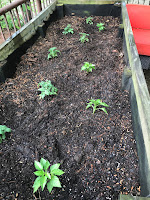 With ambulatory people we dig a bed in the ground. I do not need lumber for boxes on the ground. I also do not buy soil, compost or plastic. The role being a gardener is that of a producer not a consumer. The boxes in the barrier free gardens are of recycled materials. The compost comes from my farm or I use very old rotted manure from a horse stable for soil. It is difficult to get people to think outside the box. I either contribute my seeds or get seed donations. The mind set of being a consumer in all our activities runs deep. Regenerating a piece of land offers many rewards that are described in my book, Radical Regenerative Gardening and Farming. Sharing this fits into the concept of; the gift is in the giving. Thanks to these groups for allowing me to contribute to their programs.

 Below is John watering the beds he helped plant.
The concept of horticulture therapy is: to heal the land and let it heals us. This applies to all land use, farming gardening, etc. Connecting with the soil is a way of connecting with a part of ourselves, where we come from and where we are going back to. Nature enhances our lives. Working in a garden you find your place in nature. It is centering and allows us to put our life in perspective. While in this relaxed state I can get people to talk and share about their wonderful life or not so wonderful. As they open up they become full of the life around them. plants communicate with us on subtle levels. There is also a feeling of accomplishment when people see things grow that they planted. A garden simplifies our life. The cycle's of nature in the garden operate at a slower rhythm yet on a continuum of life. It offers insight on how the world operates in balance.At the VA center in Decatur, GA I worked with a quadruple amputee, Von Heinze, a Viet Nam vet. I thought, if he can garden anybody can. This is a rooftop garden of containers. Enable is a day center for adults that are developmentally disabled in Red Oak, GA. These are not productive gardens, nor are they focused on aesthetics. These are fun gardens. It is important to remember, that if you grow for food or you grow for your lively hood, are you having fun? This reminds me that when I am out driving around in urban cities I feel very disconnected from everything. When I am working in the garden I am in a centered, more sane environment that makes more sense to me. I also spent time at a community garden at Christian City in Union City, GA. This is a retirement community. They have boxes off the ground for wheel chair access. With ambulatory people we dig a bed in the ground. I do not need lumber for boxes on the ground. I also do not buy soil, compost or plastic. The role being a gardener is that of a producer not a consumer. The boxes in the barrier free gardens are of recycled materials. The compost comes from my farm or I use very old rotted manure from a horse stable for soil. It is difficult to get people to think outside the box. I either contribute my seeds or get seed donations. The mind set of being a consumer in all our activities runs deep. Regenerating a piece of land offers many rewards that are described in my book, Radical Regenerative Gardening and Farming. Sharing this fits into the concept of; the gift is in the giving. Thanks to these groups for allowing me to contribute to their programs.Below is John watering the beds he helped plant.
Subscribe to:
Posts (Atom)